MUSKEGON – Ernie Addicott was a senior at Muskegon Catholic Central High School back in the fall of 1960 when the brand new L.C. Walker Arena was dedicated and the Muskegon Zephyrs started playing there.
He was in the bleachers for the very first game in the new building, and said most of the fans – including himself – had little knowledge of hockey.
“At the time I had probably witnessed about 15 minutes of hockey in my life, in little clips I saw on TV, because the NHL only had six teams back then, and no regular TV coverage,” Addicott said. “I sat up in the corner on the gray bleachers the city put in there, and it was a dollar and a quarter to get in.
“The Muskegon Chronicle had all this stuff about the arena opening, and how pro hockey was coming to town, so I figured I would go support the new team. Nobody really seemed to understand the game at the time. The announcer was trying to announce while also explaining how the game worked, like why the referees were blowing whistles, what’s the blue line, what’s a two-line pass.”
That game marked the beginning of a 60-plus year relationship that Addicott has had with Muskegon hockey, from the old Zephyrs in the International Hockey League to the current Muskegon Lumberjacks of the United States Hockey League.
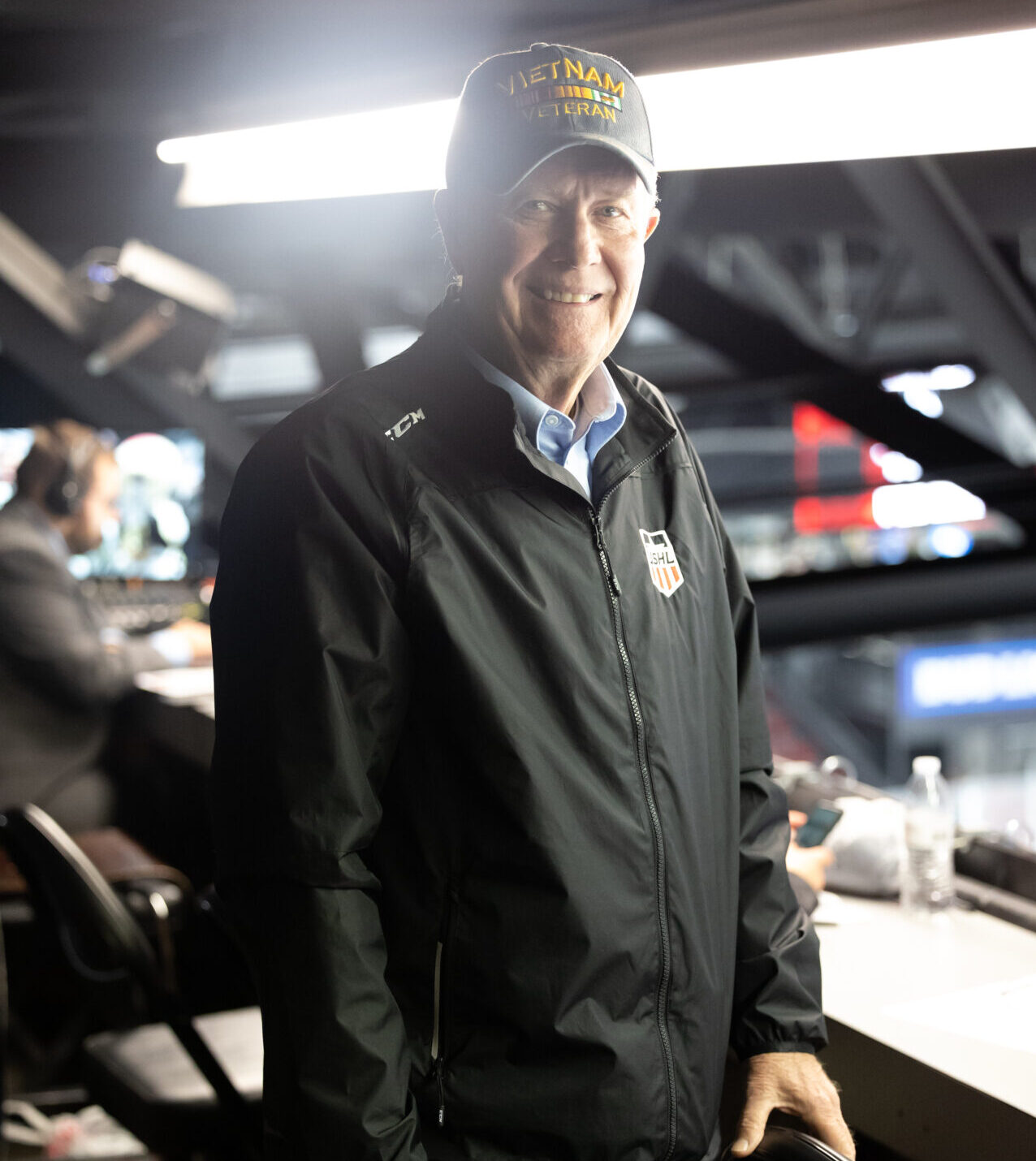 [1]
[1]He started as a longtime fan who befriended a lot of the players, and over the years has served as the team statistician, goal judge, penalty box attendant, and for the past 25 years as the official scorer.
His only real time away from Muskegon hockey came in 1966-67, when he served his country with the U.S. Army in Vietnam.
Addicott is a living, breathing history book of Muskegon hockey, and the book keeps getting thicker, because he has no intention giving up his spot in the press box any time soon.
“I’ve had a lot of people ask me if I remember this player or that player,” said Addicott, who is 78 but doesn’t look a day over 60. “There have been a lot of bodies through here since 1960, and a lot of different personalities. Some of the players were real quiet, and others were hell-raisers all the time. I’ve been very fortunate. I’ve enjoyed all of it.”
From fan to off-ice official
After attending that first game, Addicott became a loyal fan of the Zephyrs, who were later called the Mohawks. Personal connections and proximity had a lot to do with it.
His girlfriend and soon-to-be wife Seconda was the daughter of Cre Lombardi, a friend of Zephyrs owner Jerry DeLise. Addicott also worked next door to the arena for Mark Pack, a company that operated out of the old Amazon Building.
Addicott has always been a very nice guy who makes friends wherever he goes, and became close with lots of the players over the years, including Muskegon hockey legends like Bryan McClay, Lynn Margarit, Gary Ford, Bob Tombari, Darrell Knibbs and many others.
In the early days that included some late-night carousing with the players, which was against team rules at the time. The players had a 10 p.m. curfew, and the coach enforced it.
“The coach would walk into the apartment, do a bed check, and as soon as he walked out the door, they would flip off the blankets and we were gone,” Addicott said.
As the years went by, a lot of those longtime Mohawks players married, put down roots in the area and started having children. The Addicotts did the same and ended up spending a lot of time with the players and their families. As his boys grew older, Addicott started coaching their youth hockey teams, some of the pro players helped, and his time spent at the arena increased.
His father-in-law was part of a local group that purchased the Mohawks from DeLise in the 1970s, so Addicott suddenly had a family connection in the front office.
 [2]
[2]That connection became official during the 1977-78 season, when the team’s owners and longtime Mohawks General Manager/Coach Moose Lallo had a heated meeting, Lallo suddenly resigned, and the team’s scorekeepers left with him.
McClay, who was immediately promoted to General Manager/Coach, reached out to Addicott for help.
“On that Wednesday night I had been at the arena coaching my kids, Bryan was there helping me, then on Thursday morning he called me,” Addicott said. “He asked if I was going to be at the game the next night, I said I planned on it, and he said he thought he might have a job for me, and I should make sure to wear a suit.
“I walked in the back door of the arena on game night, and Dr. Harris (one of the owners) met me and told me to go to the office to see Bryan. He handed me a game sheet (for statistics), said he wasn’t sure how to fill it out, then asked me to go up to the press box and see what I could do.
“At that time, everything was done manually on paper. You kept track of all of the goals and assists on one sheet and penalties on another. After the game I gave each coach a copy, then I would get an envelope from the girl in the team office and mail the stats to the league office in Windsor, Ontario that night. It was not like now, when we keep track of all that stuff on computer and send it to the league instantly.
“There were a lot of nights when I was the only person in the press box. Sometimes the Chronicle had a reporter there. I remember (the late Chronicle reporter) Whitey Sawyer sitting next to me smoking cigars. My wife would ask me if I had been sitting by Whitey again, because she could smell the smoke on me. Everybody smoked back then. The players would step out of the locker rooms to have cigarettes between periods.”
In the old pro days, stats meant money for the players, in terms of bonuses.
“There was a player who needed one point to make bonus for the season,” Adicott said. “He was sitting next to me in the press box with a broken wrist, and he asked me to give him an assist so he could collect. But the owner was sitting two seats down from me, and I don’t think he would have been very happy about that.”
‘Some of the best fights were in the tunnel’
Over the years Addicott served many different roles with the Mohawks.
Sometimes he became an impromptu team driver, helping to deliver equipment in his car to cities like Kalamazoo, Flint or Port Huron for games, when the Mohawks could not book a bus for a trip.
“Lynn Margarit would travel with me,” Addicott said. “He would bring his pillow and blanket and rest all the way there.”
Sometimes those trips including a little bit of side fun for the players and Addicott, which didn’t necessarily fall within team guidelines.
“Some stories I won’t go into,” he said. “Let’s just say the coaches probably weren’t too happy with me at the time.”
Addicott also spent some time as a goal judge and penalty box attendant, before settling into his longtime job as the official scorekeeper.
Working the penalty box was quite a challenge back in those days. The boxes were wide open, with no glass or wire between them and the ice, and flying pucks were a constant hazard.
Players liked to jump over the boards when their penalty was over, which meant the penalty box attendant would have to carefully avoid sharp skate blades as they cut wildly through the air for a few scary moments.
The penalty box was also very busy, because there were a lot of fights and bench-clearing brawls in the lower levels of professional minor league hockey back then.
Addicott recalls one Mohawks player getting in three fights in one game.
 [3]
[3]“I asked him, what are you doing? Three fights?” Addicott said. ‘I said I didn’t want to see him in there again, and he just said, well, these guys just keep saying things that get you riled up.”
Addicott was around to watch all of the colorful enforcers – sometimes called goons – who played and brawled for Muskegon teams over the years, including Margarit, Erle Switzer, Carlo Torresan and many others who were quick to drop the gloves with opponents.
He remembers the night that Torresan was kicked out of a game, then came back on the ice in his street clothes during a bench-clearing brawl to fight Saginaw’s infamous goon, Dennis Derosier.
Perhaps the most famous Mohawks fighter was Margarit, who regularly was among the league leaders in penalty minutes.
“Lynn Margarit was one of the best friends I had,” Addicott said. “He worked for me a couple of summers at Mark Pack. Off the ice he was a great guy, but on the ice that was his job. Guys like him weren’t always necessarily the best fighters in the league, but they would battle for their teammates, no matter what. Muskegon has had several players like that.”
Addicott also witnessed quite a few off-ice fights that happened down in the guts of the arena, back when the team locker rooms were next to each other.
“Some of the best fights were down in the tunnel,” he said, “There were quite a few things the fans never saw.”
‘We’ve had our good teams and bad teams’
Addicott started working for Mark Pack right out of high school, and over a very long career advanced from clerk to company president and CEO before retiring after 52 years.
His only significant time away from the company – and Muskegon hockey – was in 1966-67, when he did a tour of duty in Vietnam. He did not see any combat, but he did operate one of the big boats that delivered the powerful weapons to the front.
Addicott smiles a lot when he talks about hockey, but his expression turns serious when the topic turns to Vietnam.
“I operated a 75-foot landing craft that brought all the heavy supplies in – mostly bombs, napalm and ammunition,” he said. “It takes a whole lot of people to run a war.
“I know a lot of damage was done to that country – hundreds of thousands of tons of bombs. It couldn’t have been pleasant.
“I had some friends who didn’t make it home. Luckily I did. I learned later on that my father had two heart attacks while I was gone.”
Addicott’s most significant years with Muskegon hockey came after his military service.
He was working for first pro Lumberjacks team when it won the Turner Cup in 1986 and 1989. That was under former owner Larry Gordon, a colorful and controversial figure from out-of-town who changed the team’s nickname from Mohawks to Lumberjacks and made it the top farm club of the Pittsburgh Penguins.
 [4]
[4]Addicott was around to watch great players like Dave Michayluk, Scott Gruhl, Jock Callendar and Todd Charlesworth play for the Lumberjacks during those years.
Many older fans consider those to be the golden years, when the team was full of talented future NHL players. But many employees of the team at that time had less fond memories, according to Addicott.
“Larry was a different kind of personality, but he knew his hockey,” he said. “I always got along with him well, but a lot of people didn’t get along with him, including many players, coaches and other employees.”
Addicott was also working for the Muskegon Fury when they won the Colonial Cup (Colonial Hockey League) in 1999, 2002, 2004 and 2005 with legendary players like Robin Bouchard, Todd Robinson, John Vary and Scott Feasby.
That era involved a step back into the lower-level minor league world, where the skill level was not as good, but there were lots of fights and fierce competition.
“The Zephyrs won in the beginning, and when Larry owned the team it won championships,” said Addicott, who remembers drinking beer out of the Turner Cup one time. “The Fury also had some great teams and won some championships.
“We’ve had our good teams and bad teams. I really think it goes in cycles.”
Grateful hockey is still in Muskegon
Addicott watched with concern several times throughout the years, when the future of hockey in Muskegon was very much in doubt.
He learned that back in the old days, Jerry DeLise had an option to purchase a big chunk of land near Coopersville, and supposedly talked to Cre Lombardi about the possibility of building a new arena on that property and moving the team there.
Of course that never happened, but there have been similar situations when the future of hockey in Muskegon looked cloudy.
The group that owned the old Mohawks was on the brink of shutting the franchise down, then found a last-minute buyer in Gordon, who purchased the franchise for $1 in 1984.
Gordon ended up moving the team to Cleveland in 1992, but then Tony Lisman came along and established the Muskegon Fury, which competed in the Colonial Hockey League the next season.
 [5]
[5]The Fury was sold to local investors who changed the nickname back to Lumberjacks, but they eventually ran into revenue problems and ceased operations in Muskegon following the 2009-10 season.
Just as that team was leaving, the new Lumberjacks rose as part of the United States Hockey League, an elite development league for some of the top young junior players in the world.
The second owners of the new Lumberjacks had problems selling the team after the 2014-15 season, and there was talk of a league takeover of the franchise, or perhaps a shutdown. Luckily current owner Dan Israel, a Detroit-area resident, bought the Lumberjacks that summer, and eventually formed a partnership with co-owner Bob Kaiser.
Addicott sometimes looks over his late father-in-law’s old hockey business papers and realizes how much he sacrificed as a member of three different ownership groups with the old Mohawks. He’s grateful that there have always been new owners willing to invest and keep the hockey tradition alive in Muskegon.
“I just sort through some of that old stuff sometimes and realize what they went through, the investments they had to make, and how much money they really lost,” Addicott said about Cre Lombardi and his partners. “I am thankful that hockey is still going on here. I am grateful that someone came along after the pros left.”
Addicott has high praise for Israel and Kaiser, who worked with the city to make significant improvements to the arena in 2018, and have worked hard to keep a winner on the ice and fans entertained.
“I don’t know how much of a money-maker it is at this level,” he said. “How many ownership groups have there been in the last 10 years? The current owners are really dedicated to what we are trying to do.”
‘The house that Walker built’
Like many older fans, Addicott admits he was skeptical when pro hockey left town and the junior hockey Lumberjacks replaced it.
Then he witnessed the high level of play, and the many scouts from NHL and college teams coming to town to watch the talented young players, and he realized Muskegon was part of something special.
One of his current favorite players is first-year Lumberjacks Gavin McCarthy, a defenseman that Addicott believes has a lot of potential.
“At the very beginning I was cynical, because I kept hearing it was a bunch of high school kids, but right away I saw that the skill level of these guys, compared to high school, is a lot different,” Addicott said. “As hard as they work and play, sometimes they are better than the pros.
“The old pros knew they were going to get a paycheck, and sometimes when they got a few goals behind, it would seem like they would just play it out so they could get out of there and go to the bar or wherever. But these guys know where the future could lead them, and what they have to gain by playing hard for a full 60 minutes.”
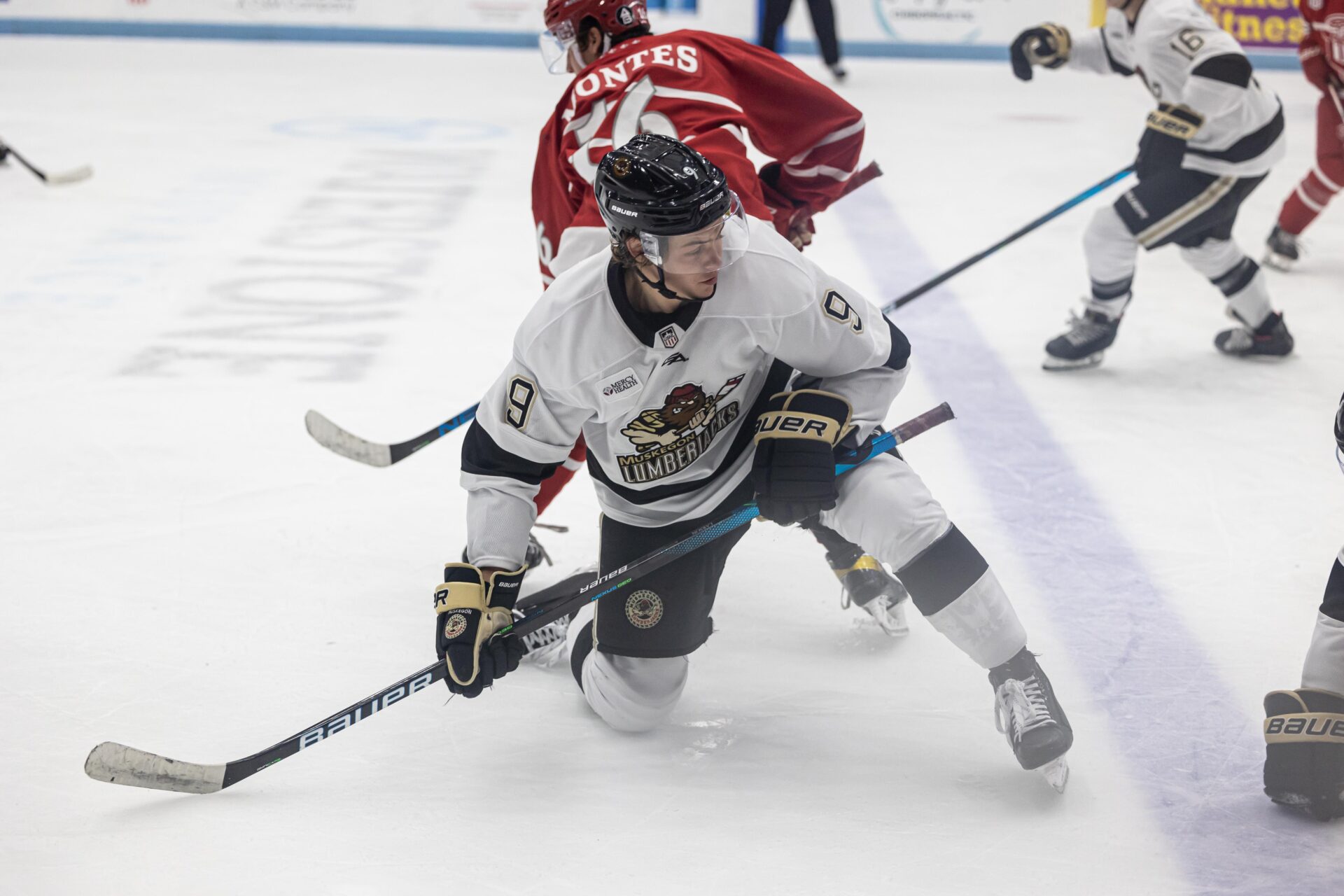 [6]
[6]One change that did not please Addicott occurred last year, when L.C. Walker Arena was renamed Mercy Health Arena as part of a sponsorship deal. He remembers when Mr. Walker, a local industrialist and philanthropist, built the arena as a gift to the city, and he believes the building should have kept his name in perpetuity.
“To me, this is the house that Walker built,” he said. “He only spent about a million dollars, but back then that was a lot of money.”
Addicott is no longer the full-season official scorer for the Jacks, but that’s only because he and his wife purchased a winter home in Fort Myers, Florida about 15 years ago, and leave every year after the holidays. But he’s in the press box doing his normal job at the start of every season, from the first home exhibition game through Jan. 1.
If the Lumberjacks make the playoffs in the spring, he’s back to work those games as well.
“I don’t miss it quite as much as I did before when I can’t get to a game,” he said. “There were times when hockey came before my family, and they probably suffered for it. I would be down here seven nights a week, going to games and coaching.”
Addicott says he’s pretty sure that most of the off-ice game officials he started working with back in the 70s have passed away, but he remains in good health and doesn’t see any reason why he should stop working the games any time soon.
“I have friends with a lot of different hobbies, but I really never had a hobby,” he said. “I just continued to work, and I still enjoy working. As long as I have my health I will keep going.”